
How we treat Sever’s disease – and prevent it from coming back

Updated: Aug 20
Discover what treatments work best for Sever’s disease (heel pain in children), how to help the symptoms to settle, and – just as importantly – how to prevent them from coming back. This guide explains the evidence-based strategies we use with our patients, with practical tips you can start applying straight away.
Remember, if you need help with an Achilles injury, you're welcome to consult one of our team via video call.

The terms tendinitis, tendonitis, tendinosis, and tendinopathy mean the same thing for all practical purposes, and we use these interchangeably in most of our articles.
In this article:
We've also made a video about this:
This article contains affiliate links. We might earn a small commission on sales at no extra cost to you.
Quick recap of Sever’s
At Treat My Achilles, we believe that it’s much easier to follow a treatment plan if you understand what caused your injury and how the treatments are supposed to help it recover. So, let’s start with a quick recap of the most important aspects of Sever’s:

Sever’s disease is inflammation and irritation of the growth plate at the back of the heel, where the Achilles tendon attaches to the heel bone.
It’s caused by excessive traction (pulling) of the Achilles tendon on the growth plate – the scientific name is traction apophysitis.
It’s an overuse injury and usually develops when children do very high volumes of sports that involve jumping and running, which cause strong contractions in the calf muscles that in turn pull on the Achilles tendon.
Sever’s is usually linked to growth spurts in children – bones grow faster than muscles and tendons (soft tissues), which can make the soft tissues tight and increase the pull on the Achilles tendon.
This pulling can be made worse by other factors, like poor foot posture or lots of running and jumping.
Sever’s usually responds well to simple treatments, including rest and exercises.
Symptoms can come back during growth spurts, but children usually grow out of it once the growth plates fuse.
👉 We’ll divide the treatments into two main categories:
Treatments that help the symptoms to settle and allow recovery to start.
Treatments that address the cause and help to prevent the pain from recurring.
Treatments that help Sever’s symptoms to settle
⭐ Relative rest
We’ve given relative rest a gold star because it’s the most important part of the treatment plan – and it’s usually the only one that every child needs. The other treatments we discuss further down are helpful in some cases but not in others, which is why it’s a good idea to consult a physiotherapist about this.
Relative rest – as opposed to total rest – means helping your child to stay as active as possible while still giving the injury time to settle. So, rather than stopping all activities, you cut out the most aggravating ones or scale things back to a level that doesn’t flare the symptoms up.
👉 So, it’s important for parent and child to discuss which activities matter most right now and how you can tweak them to calm the pain down.

💡 The goal is simple: Getting the pain under control sufficiently for the child to walk normally again. Once that’s been achieved, the rest of the treatment plan tends to work much better.
Here are some examples:
Sports that involve lots of running and jumping may be swapped, for now, for non-weightbearing options like cycling or swimming.
Some children play the same sport for multiple teams (for example, football at school as well as for a club). It can help to stick to just one team for the time being.
You can also agree with coaches to dial back sprinting and jumping drills in training and focus more on technique for now.
If treadmill running is the go-to in the gym, try switching some of that time to the cross-trainer.
Don’t forget non-sport activities, too. If your child is spending loads of time on their feet (for example, long walks or busy days out), it may be worth cutting back a bit while symptoms settle.
If they do dancing, can they be marking out the moves and only practice some bits without jumping or hopping?
Shoes and insoles
Shoes where the heel is higher than the toes and that provide good support can reduce the pulling and strain on the Achilles tendon and help the symptoms to settle more quickly.

Some kids can also benefit from adding heel-lifting insoles or arch-support insoles (if they overpronate) into their shoes.
👉 We’ve written detailed articles about how to assess your child’s shoes, with examples of shoes and insoles, which you can find here:
Tape
There isn't much research yet into whether taping a child's foot can help with Sever's disease or not. The little bit of research that is available suggests that it might help to reduce symptoms in some children but not in others – and this also fits with our experience.
Both kinesiotape and more rigid taping techniques aimed at supporting the foot and ankle have been shown to be useful.
We'll make some videos that demonstrate these techniques (coming soon), but we tend to find that good shoes (with insoles if needed) is a more lasting and practical option, since taping usually requires frequent reapplication and someone to apply it.

Anti-inflammatory medication (NSAIDs)
If you’ve watched any of our videos about Achilles tendinopathy or tendonitis, you might have heard us say that anti-inflammatories aren’t really useful for those.
However, Sever’s is not the same type of injury – with Sever’s there is quite a bit of inflammation present. So, if a child’s pain is severe or it’s struggling to calm down, anti-inflammatory medication might be useful.
That said, even though these medications are readily available, it’s always best to see if you can calm things down without having to resort to them.
👉 Also, if your child is in so much pain after a training session that they need medication, the training session really needs to be adjusted. Their injury will struggle to settle down or recover if they keep pushing into that much pain and irritation.
Ice
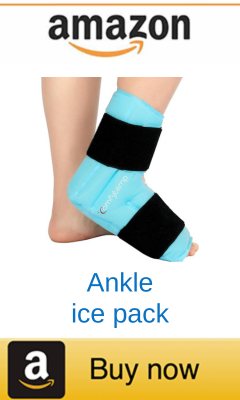
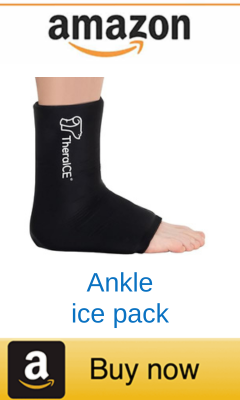
Ice packs can help to calm pain down and don’t have the systemic effect of anti-inflammatory medication. You can buy reusable ice packs online, but if you’re making your own or using something like a bag of frozen peas, be sure to wrap a cloth around it so that the skin doesn’t get ice burns.
Applying ice after an exercise session can be particularly useful to help things calm down.
Ice should only be applied for short periods at a time (10 minutes), but you can usually repeat the ice treatment for another 10 minutes if you’ve given the area about 10 minutes to recover. So, ice on for 10 minutes, then ice off for 10 minutes, reapply for 10 more minutes.

Orthopaedic boots
In some rare, severe cases that don’t want to calm down otherwise, the child’s foot is put in an orthopaedic boot for a brief time to immobilise the foot and take the weight off it until the pain has decreased.
💡 In our experience, boots can usually be avoided by wearing good shoes and heel-lifting inserts and applying the concept of relative rest properly.
Treatments that address the cause of Sever’s
Exercises for muscle and nerve tightness
Most people think about calf muscle stretches when we talk about exercises for Sever’s, but these can actually make things worse if you start them too early. And you also have to think about the muscles higher up in the legs.
It’s not just the muscles that get tight during a growth spurt – we also have nerves throughout our bodies which can be affected.

The nerves flow from the spinal cord to the tips of our toes and fingers and are meant to slide and glide as we move. Before I studied physiotherapy, I used to think nerves were tiny, fragile things, but in reality they are strong cords – the thickest is your sciatic nerve in the back of your thigh, which has roughly the same diameter as your thumb!
💡 So, yes, a treatment plan for Sever’s should include muscle stretches but also nerve mobilisation exercises.
👉 Stretching forms such an important part of the treatment of Sever’s that Alison has written a detailed article about what stretches to do (with examples). She also explains when to introduce calf stretches and what to do while you can’t stretch them.


Exercises that improve strength and control
If your physio determined that poor strength or movement patterns might have contributed to your child’s specific case, these need to be addressed as part of a lasting solution.
These exercises can often be included in your child’s regular sports warm-up or training sessions. It can be something they do while they sit out other parts of the training session to allow their heel to rest.
Exercises that could be useful include:
Calf strengthening – physios can easily test if this is needed by checking how well and how many calf raises your child can do on a single leg.
Balance – growth spurts can cause a temporary decrease in balance while the brain figures out how to properly control and move limbs that are suddenly longer than before.
Foot muscle posture and strength – these can be useful if your child’s foot rolls in excessively (overpronates) when they run and walk.
Hip control – these can be useful if your child’s legs turn in excessively when they walk, run, or jump.
Treatments to avoid
The following treatments are either unnecessary or might actually work against your child's recovery in the long term:
Ankle braces – These are designed to provide side-to-side stability for the ankle joint, which is really useful when you've injured a ligament. But they don't address any of the issues that cause Sever's disease. You're better off investing in good shoes and insoles.
Corticosteroids (also called steroids or cortisone) – These are very effective at calming pain down thanks to their strong anti-inflammatory properties. However, research has shown that they can have negative effects on long-term healing – particularly on cartilage and collagen (the building blocks of your child's growth plates and tendons). They really shouldn't be used for this type of injury in children.

How to prevent Sever’s disease from coming back
Notice growth spurts
Every time your child experiences a growth spurt, it will temporarily increase the tightness in their soft tissues (muscles and nerves), which can lead to Sever’s recurring.
💡 However, you can navigate growth spurts without much trouble if you’re proactive and encourage your child to stretch regularly and pay attention to how much sport or activity they’re doing in that period.
This is why we always make sure to take time during a consultation to explain both to parents and children how this injury works and how the treatments we suggest are meant to help. This way, they can take control and react quickly when symptoms start to recur, which usually leads to much improved recovery times.

Sensible sports schedules
Because this is an overuse injury brought on by too much and/or too intense activity, managing the child’s training programme is the most important part of preventing Sever’s disease from coming back after the initial bout has calmed down. Training should be looked at in terms of volume as well as intensity.
Training volume
Alison explained in an earlier article that the risk of Sever’s disease is higher when a child has a spike in activity at the start of a school term or a sports season. It could also happen when the type of activity changes suddenly, e.g. from cross-country running to doing lots of hill sprints.
💡 A useful rule of thumb for running activities is that the volume shouldn’t increase by more than 10% per week.
This is based on research that focused on running, but it has been shown that any sporting activity that jumps more than 30% in volume can help to irritate injuries over a period of time.
Coaches are in the ideal position to help a child safely ease back into their sport. If a coach or the school’s PE teacher, rather than the parents, controls the child’s training programme, it might be a good idea to talk to them about ways to keep the child’s training volume increases within that 10% range – for example, by having them sit out some activities or reducing the time they spend on certain activities.
Pain or discomfort during or after activity should never exceed a score of 3 out of 10, with zero meaning all is good and 10 meaning intense pain.
🚨 Warning signs that the training volume is still too high include:
more pain or discomfort in a given week than the previous week,
more “bad” days than “good” days,
and an increase in the time it takes to recover after a large amount of activity.
If these warning signs are not heeded, a child can easily fall into the “boom-and-bust” cycle of overtraining, where they have to take a total break from training due to the Sever’s disease flaring up again, and then they go back to training at full tilt when the pain has calmed down, only to have to sit things out once more after the injury has appeared yet again.

Training intensity
Low-intensity activities would be those where the child can have a normal conversation while doing it, moderate would be where they have to catch their breath every so often, and high intensity would be where they can’t get out more than a few words at a time.
💡 A good rule of thumb here is 80% low to moderate intensity and 20% high intensity per week.
Again, this is a good basis for a conversation with a coach about in which activities the child should take part and which ones they should sit out.
Rest days are important after high-intensity training sessions, and/or before an important race or match. These are also an opportunity to take stock of the situation. “How is my pain level compared to last week?”
Other ways to avoid a recurrence
Take care of your child’s general health, including a healthy diet, proper hydration, and enough sleep.
Where possible, train on softer, sprung surfaces rather than hard floors.
Don’t train in worn-out shoes. The rule of thumb for running shoes is that they should be replaced every 500 miles or 6 months, whichever comes first.
If a sport is played barefoot, look at possibly doing some of the training, as well as warm-ups and cool-downs, in shoes.
Is the child’s warm-up routine, including how they stretch, correct? Our sister site, Sports Injury Physio, has a good article about the components of a good warm-up routine and one about how to use static stretches correctly when warming up.
Something that is being discussed in medical circles but that hasn’t been researched properly is whether specialising in a single sport from an early age – exerting the same forces on the child’s body over and over again – could predispose the child to getting Sever’s disease and other injuries.
How we can help
Need help with your Achilles or related injury? You’re welcome to consult one of the team at TMA online via video call for an assessment of your injury and a tailored treatment plan.

We're all UK Chartered Physiotherapists with Master’s Degrees related to Sports & Exercise Medicine or at least 10 years' experience in the field. All of us have a wealth of experience working with athletes across a broad variety of sports and ranging from recreationally active people to professional athletes. You can meet the team here.


About the Author
Maryke Louw is a chartered physiotherapist with more than 20 years' experience and a Master’s Degree in Sports Injury Management. Follow her on LinkedIn and ResearchGate.


