
How to optimise platelet-rich plasma (PRP) outcomes for Achilles tendonitis or tendinopathy
Updated: Sep 11
Platelet-rich plasma (PRP) for Achilles tendonitis is sometimes effective ... and other times not. The outcome depends on a number of factors, and fortunately there are things you can do before and after a PRP injection to stack the odds in your favour. Here's how.
Remember, if you need help with an Achilles injury, you're welcome to consult one of our physio team via video call.
The terms tendinitis, tendonitis, tendinosis, and tendinopathy mean the same thing for all practical purposes, and we use these interchangeably in most of our articles.
In this article:
I've also made a video about this:
What is PRP and how might it help your Achilles tendon?
Your blood is made up of many cell types, each with unique properties and functions – the most well-known are red blood cells and platelets.
The platelets release various substances that boost pro-inflammatory processes, as well as a variety of growth factors, which might mean that it can stimulate or support tissue repair and healing.
When you have chronic Achilles tendonitis or tendinopathy, some of the tendon cells (mostly collagen) have broken down, and sometimes that area of the tendon seems stuck in this injured state – it doesn’t want to heal.
💡 So the thinking is that if you inject platelets into the injured part of the tendon, it might kickstart the healing process.
But does PRP actually work for Achilles tendonitis?
Studies on animals have shown that high concentrations of platelets that release these substances can decrease pain and stimulate healing – especially collagen growth.
Now, this sounds brilliant and like a no-brainer, but PRP doesn’t always seem to work that well on humans.
A recent umbrella review, where researchers collected and analysed all the previous meta-analyses and reviews on PRP, found that there is no strong evidence to show that PRP definitely works better than placebo or other types of treatment for Achilles tendonitis … but also, there’s no strong evidence that PRP doesn’t work.
💡 And this is also what we find in practice – some patients have a great response to it, and others notice no difference. So, what’s going on?
As it turns out, there are many factors that can influence the quality of the PRP solution that is injected and whether the injection is done in the correct place, and all these can influence how well your body responds to the PRP. And what you do after the injection also matters.

The current research studies have all used such different PRP methods and post-injection protocols that it’s impossible to know how much of the result was down to the PRP and how much was down to what the researchers and the patients did.
However, we are starting to understand better what factors might ensure the best outcomes, and we’ll hopefully see more robust research studies in the future.
Let’s take a closer look at what factors might impact how well PRP works and what you can do to optimise your results.
Factors that can influence PRP success
PRP should only be used for Achilles tendons that have been injured for more than three months and are not showing any signs of healing despite the patient doing all the right things.
Why not use it earlier? If your tendon injury is less than three months old and/or you’re making progress (even if it’s slow), your tendon’s healing process is working as expected. PRP is only used when the healing process is failing.

When you get a PRP injection, your doctor usually follows these steps:
They draw your blood.
Then spin it at high speed, which separates the blood into different layers.
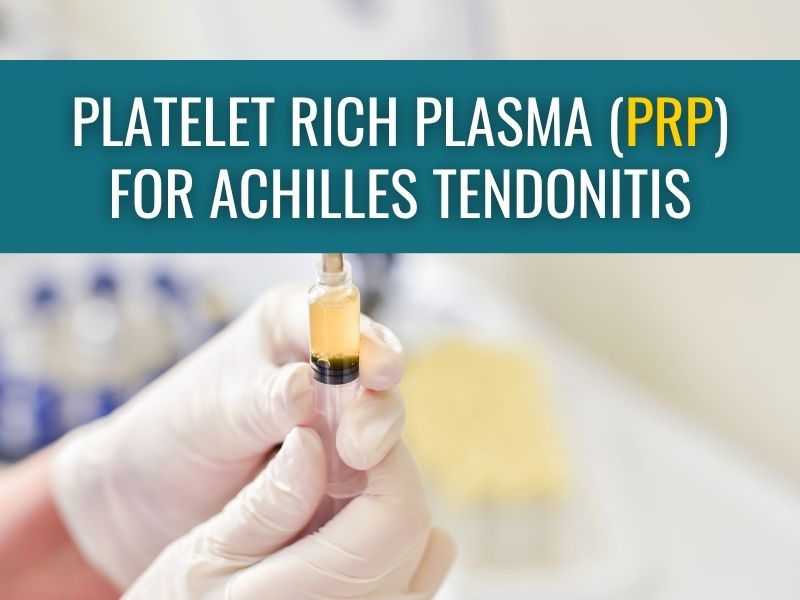
They then draw off the yellowish layer that contains plasma and a high concentration of platelets (hence the name platelet-rich plasma).
At this point, they might add other substances that are thought to help the platelets to release their growth factors better.
The PRP solution is then injected into the injured area while the doctor uses an ultrasound scanner to check that the needle is going into the correct place.
If PRP doesn’t work, it’s easy to think that maybe the doctor did something wrong. But the interesting thing is that researchers have found that the quality of the PRP solution can vary dramatically even when the blood is drawn from the same person and prepared in exactly the same way on two different days.
There are three categories of things that can influence how successful your PRP injection is:
How healthy your platelets are and how many growth factors they have to release on the day your blood is drawn.
How good the procedure the doctor follows is at getting a suitable concentration of platelets into the correct area of the tendon.
Whether you’re creating the optimal environment for your body to respond and use the growth factors after the injection.
Let’s look at each of these categories and what you can do to optimise your results.
How to optimise your platelet quality
Your health, nutrition, and stress levels can affect how many platelets you have in your blood and how many growth factors and substances each platelet has available to release.
Researchers have found that the following factors can impact your platelets:
High levels of mental stress (like public speaking or doing a maths exam) or physical stress (very hard exercise sessions) are a problem. Your platelets naturally release their useful compounds during these situations to help your body cope better, so they might not have much left if you have your PRP procedure around the same time.
Diets that are high in the following can affect your platelets:
saturated fats
sugar
simple carbohydrates
caffeine
quercetin (a flavonoid present in high levels in onions, apples, tea, and wine)
isoflavones (found in chickpeas and soybeans).

Alcohol, smoking, and vapes that contain nicotine aren't good.
Certain medications can also affect your platelets, of which the most common ones are:
anti-inflammatory medication (NSAIDS)
antihistamines
antibiotics.
💡 To give your platelets the best chance to be healthy and fully loaded, it might be worth paying a bit more attention to what you eat, drink, and do in the week leading up to your procedure. And scheduling it for a time when you know you’ll have less work or family stress is a good idea.
What an optimal PRP procedure looks like
If you use a reputable clinic, chances are that the procedure they follow will be good enough, but I would just confirm that they do the injection under ultrasound guidance.
Researchers seem to agree that doing the injection under ultrasound guidance is likely to give better results as opposed to simply sticking the needle into the painful part of the tendon. Ultrasound guidance means that the doctor does an ultrasound scan while injecting the PRP to check that the needle is going into the correct area – same as when they look at a foetus.

There is no evidence to suggest how many times the solution should be spun, whether adding any substances truly helps the platelets release more growth factors, and how many injections are ideal.
How to optimise your Achilles tendon’s response to the PRP
The PRP solution helps to create the conditions for healing to take place, but this doesn’t mean that you can just sit back and wait for your Achilles tendon to heal. You still have to get your body to take advantage of the growth factors to strengthen the tendon.
The signal that triggers tendons to grow stronger is when you exercise them and place progressively heavier loads through them. A 2026 Consensus Statement by a team of 23 doctors who are experts in the field of sports injury rehabilitation as well as PRP treatment highlights the importance of combining PRP injections with a progressive loading programme (gradually increasing strengthening exercises and activity levels).
🤔 Now, you’ve likely tried a rehab plan before without much luck. The difference is that this time the tendon has all those growth factors from the platelets to help kickstart the strengthening process and get healing under way.
👉 But it’s important not to jump in with heavy strength training immediately. Here’s an example of a typical protocol that researchers used in their studies.

The first 72 hours after the injection
The doctor usually also injects a small amount of anaesthetic during the procedure, which means that your Achilles might feel a bit numb for a few hours.
It’s quite normal to experience some pain in the injected area once the anaesthetic wears off, and this can last for a few days. You might also notice swelling and bruising.
It is usually OK to take mild painkillers like paracetamol, but you should ❌ avoid anti-inflammatory medications (like ibuprofen, naproxen, and aspirin), since they can limit the inflammation created by the platelets, which is needed to kick-start the healing process.
Icing your Achilles tendon for short periods (10 minutes on, removing it for 10 minutes, then a final 10 minutes on) might also help for pain – just don’t sit with the ice on the area for long periods of time.
Your doctor will likely tell you that it’s OK to walk short distances but to avoid very intense walking or other types of exercise – basically, to take things very easy.


Day 3 to 10
You can usually start easing into specific calf and Achilles strengthening exercises after three days, but these should be easy and low-load exercises. There’s no one-size-fits-all plan for this – your physio will pick the best type of exercises (position, reps, weight, frequency) for your specific case.
It’s usually also OK to start low-impact cardio exercise that doesn't really load the Achilles tendon too much, e.g. cycling, rowing, or swimming. Try to still keep things easy, e.g. limit sessions to 40 minutes max and not on consecutive days.
After Day 10
At this point, you can usually ease back into heavier strength training for your Achilles according to what your symptoms allow, and all the principles of a well-structured rehab plan for Achilles tendonitis apply.
💡 If you were stuck with your rehab before, the effect of the PRP should now help you to progress and regain the strength you need to do your chosen activity or sport. It is often only around six weeks after having the PRP that our patients start noticing that things are improving significantly compared to before.
It is also OK to ease back into higher impact activities like running if your Achilles is ready for it. You can find a detailed discussion here on how to decide if you’re doing the right level of exercise to still allow your Achilles to heal and grow stronger.
How we can help
Need help with an Achilles or related injury? You’re welcome to consult one of the team at TMA online via video call for an assessment of your injury and a tailored treatment plan.

We're all UK Chartered Physiotherapists with Master’s Degrees related to Sports & Exercise Medicine or at least 10 years' experience in the field. All of us have a wealth of experience working with athletes across a broad variety of sports and ranging from recreationally active people to professional athletes. You can meet the team here.


About the author
Maryke Louw is a chartered physiotherapist with more than 20 years' experience and a Master’s Degree in Sports Injury Management. Follow her on LinkedIn and ResearchGate.


