When can I run after an Achilles tendon rupture?

If you've ruptured your Achilles tendon, you might be wondering when you can start running again and how to do it without risking another injury. The answer depends on more than just how much time has passed since your rupture. Learn what boxes you must tick to ensure that your calf muscles and Achilles tendon regain enough strength, endurance, and control to cope with the demands of running.
Remember, if you need help with an Achilles or related injury, you're welcome to consult one of our physio team via video call.

The terms tendinitis, tendonitis, tendinosis, and tendinopathy mean the same thing for all practical purposes, and we use these interchangeably in most of our articles.
In this article:
We've also made a video about this:
When can I start thinking about running again?
Your calf muscles (gastrocnemius and soleus) connect via your Achilles tendon onto your heel bone, and they all work together to propel you forward as you walk, run, and jump.

Returning to running after an Achilles tendon rupture isn't simply a matter of waiting a certain number of weeks or months. It's about making sure your calf muscles and Achilles tendon have recovered enough to cope with the forces involved in running.
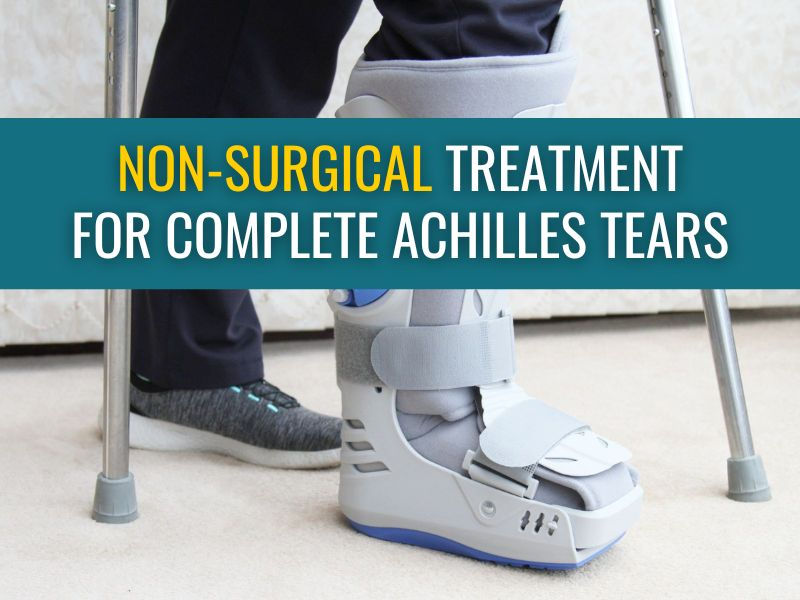
After a complete Achilles rupture, you'll typically have spent some time in a cast or orthopaedic boot with your foot pointing downwards (a position called plantar flexion). This keeps the ends of the ruptured tendon closer together while it heals and helps prevent it from healing in an overly lengthened position, which could affect its long-term function.

During this initial phase, you will have followed a specific rehabilitation protocol designed to protect the healing tendon. Once you've completed this phase and started doing strengthening exercises, the next step is to rebuild the strength, endurance, and control needed for running.
You might be walking normally, experiencing no pain, and feeling confident that your Achilles has healed. But running places very different demands on your tendon compared to walking.
Not only are the forces greater, but your Achilles also has to absorb and release those forces repeatedly, at speed, with every stride.
So, before you start running, you need to make sure your tendon has the capacity to cope with those demands.
💡 It's important to understand that feeling good during your day-to-day activities doesn't necessarily mean you're ready to run.
Google Advert
Building running strength
The key to rebuilding your calf and Achilles strength after a rupture is progressive loading. This means gradually increasing how hard your muscles and tendon have to work so that they adapt and become stronger.
If you keep doing the same exercises with the same resistance, you'll get better at those exercises, but you won't necessarily continue building strength. To become stronger, your muscles and tendon need to be challenged progressively.

Early on, when you've just come out of your boot, you might find even a simple heel raise quite difficult. Think of your rehabilitation as climbing a ladder.
You start on the bottom rung and gradually work your way upwards as your strength and ability improve. At the top of the ladder, your rehab exercises and other activities (like walking endurance) should start to resemble the force and endurance you need to safely ease into running.
Your strengthening programme will usually begin with exercises that place relatively little load on your Achilles, such as:
Isometric exercises: Holding a position without moving; for example, going up on your tiptoes and then holding that position.
Double-leg calf raises: Raising your heels while standing on both feet, so that the load is shared between your legs.
As you become stronger, your exercises can be progressed to more demanding activities, such as single-leg calf raises and longer periods of walking.
Later in your rehabilitation, you might be ready to introduce jumping and hopping exercises. These place substantially more load on your Achilles and should only be introduced once your physio is satisfied that you're ready.

The important thing is not to rush up the rehabilitation ladder. The process your Achilles tendon goes through to grow stronger in reaction to the exercises requires lots of time.
💡 So, it’s not just about hitting a certain number of reps or sets or using a specific weight, but also about making sure that you do the exercises for a long enough period to allow this process to fully take place.
👉 If you progress too quickly, you might be asking your Achilles to cope with more load than it's currently capable of handling and experience a flare-up or injury.
What boxes must I tick?
Unfortunately, there isn't a single test or universally agreed set of criteria that can tell us with certainty when someone is ready to run after an Achilles rupture. However, there are some tests which, when combined with other information from your own rehab progress and injury history, can help your physio understand when you might be ready.
In early 2026, a group of 35 Achilles specialists considered which criteria should be used when assessing readiness to return to running.
They reached a consensus on seven factors worth considering:
Pain-free daily activities. You should be able to go about your normal day without experiencing Achilles pain.
Good tolerance of rehabilitation exercises. Your strengthening exercises shouldn't cause a significant increase in pain or other problems.
Normal walking. You should be walking without a limp or obvious differences in movement between your injured and uninjured sides. You also shouldn't be compensating by moving other parts of your body differently.
The ability to walk on your tiptoes. This demonstrates some ability to push up through your calf muscles and Achilles tendon.

Good single-leg balance. You should be able to balance on your injured leg with good control.
Good single-leg heel raise capacity. Your calf and tendon should be strong enough to perform single-leg heel raises with quite a lot of extra weight added (we determine the amount of weight by looking at the patient’s bodyweight).
Psychological readiness. You should feel mentally ready to start running again. Fear of re-injury and a lack of confidence can affect how you move and perform.
💡 These criteria provide a useful starting point, but they have limitations.
For example, what exactly does “good single-leg balance” mean? How long should you be able to balance? Should you be able to do it with your eyes closed or while standing on an unstable surface?
Similarly, being able to perform single-leg calf raises is important, but how many should you manage? Should you be able to lift your heel as high as you can on your uninjured side? How much extra weight should you be able to lift?
The seven criteria haven't been individually validated as reliable tests for returning to running after an Achilles rupture. They are therefore best used as part of a broader assessment rather than as a simple pass-or-fail checklist.
👉 In our clinical assessments, we also consider things such as:
How many single-leg calf raises you can do and how their quality, height, and endurance compare between your legs.
How much additional weight you can manage during calf raises.
Whether you're able to jump and hop with good control and comparing your performance between your injured and uninjured sides.
Our rehab aims for balance will be influenced by what type of running you want to get back to e.g. are you a trail runner who needs very good balance and control, or a sprinter whose Achilles needs to cope with strong, explosive forces.

For jumping and hopping, we might assess the height, distance, or speed of the movements. However, we wouldn't introduce these tests until you're strong enough to perform more demanding single-leg calf raises.
Jumping and hopping are also not appropriate for all runners – other injuries or your general physical condition might mean that we decide against adding these types of exercises into your rehab and rather use a very graduated return-to-running plan to gain the necessary strength.
There's no single box you can tick that automatically means you're ready to run. Your physio needs to look at all these factors together, taking into account your individual circumstances and the type of running you want to return to and tailor your plan accordingly.


How to ease safely into running post-rupture
Once your physio has assessed you and given you the green light to start running, the next step is to build up strength gradually. You can never fully build running strength and endurance through the rehab exercises alone – this can only be done with a graduated running plan.
💡 A useful way to approach this is to think of VIP: Volume, Intensity, and Plan.
1️⃣ Start by building volume
Your first runs will typically involve a combination of jogging and walking.
This allows you to start exposing your Achilles to the demands of running without immediately asking it to cope with a continuous run.
Initially, your running sessions might be quite short. You might even run just once a week while you continue working on your calf and Achilles strength.
What matters isn't simply how many minutes you can run. You also need to monitor:
The quality of your running movement and whether you're compensating for your injured leg.
How quickly your calf muscles fatigue.
How your Achilles feels during the session.
How it responds over the following 24 hours.
If you're coping well, you can gradually increase the total number of minutes you spend running.
Your target running volume will depend on what you want to achieve. Someone who wants to jog for 30 minutes a few times a week will have very different requirements from a marathon runner, ultramarathon runner, or triathlete.
That's why your return-to-running programme needs to be tailored to your goals.
Google Advert
2️⃣ Then introduce intensity
Once you've built up to your target easy-running duration and are coping well with that, you can start thinking about running faster. Speed places different demands on your calf muscles and Achilles tendon.
💡 As you run faster, you may naturally land more towards your midfoot or forefoot. This changes how your Achilles is loaded compared to slower jogging – the faster you run, the more force goes through your Achilles.
Your return to faster running might therefore progress from easy jogging to:
Moderate-paced running (tempo runs),
Followed by carefully controlled faster intervals.
Eventually, depending on your sporting goals, you might introduce short bursts of acceleration.
For example, when you’re ready to start working towards sprinting, you would start with a 10-20% harder effort than your easy-running effort during your short sprint sections. You can then gradually increase this effort over several weeks until you’re back to your normal max-effort sessions.
The same principle of gradual progression applies when you start changing the terrain or elevation you're running on. Running on trails, concrete, treadmills, and soft sand all place different demands on your body.
💡 To avoid overwhelming your recovering tendon, it's usually best to only change intensity in a single way e.g. you can choose to increase either pace, distance, or switch to a more challenging terrain, but be careful to increase two or more at the same time.

Have a plan
Your running programme should be designed around your eventual goal rather than simply increasing your running because you feel capable of doing more.
It's also important to balance running with your ongoing strength training.
💡 As your running volume and intensity increase, you will likely need to reduce the volume of calf strengthening exercises you’re doing. If you don’t adapt your rehab exercises, the combined load from those plus the increased running might cause your Achilles and calf muscles to become overworked and injured.
That doesn't necessarily mean reducing the weight or number of repetitions. You might simply do your strength sessions fewer times per week or drop some of the exercises (like hopping and jumping.)
The aim is to find the right balance between building your running capacity and continuing to develop your calf and Achilles strength.
Google Advert
Re-rupture risk
One of the biggest concerns people have when returning to running after an Achilles rupture is whether the tendon might tear again.
Unfortunately, it's difficult to give a reliable percentage for your individual risk of re-rupture. Different studies report different figures, partly because they don't all define or measure re-ruptures in the same way.
There are also substantial differences in how people are treated and rehabilitated after an Achilles rupture. For example, some people have surgery, while others are treated without surgery. The speed at which someone progresses through rehabilitation, the exercises they perform, and how well they regain their strength and function can also vary considerably.
Your individual circumstances matter too. Factors such as your age, general health, other injuries, previous movement problems, and lifestyle can all influence your recovery.
This means that the re-rupture percentages reported by different studies can't simply be combined to give a reliable prediction of what will happen to you.
💡 However, you can significantly reduce your re-rupture risk by making sure your rehabilitation progresses at a pace that's appropriate for you and that you've developed the strength and capacity needed before increasing the demands on your Achilles.

Maintenance
Once you're back running regularly, you might be tempted to stop doing your calf strengthening exercises.
However, we don’t always use our calves in a way that maintains optimal strength, and returning to running doesn't necessarily mean you've regained all your previous strength. Research looking at strength differences between the injured and uninjured legs has found that deficits can still be present more than a year after an Achilles rupture.
This is why ongoing strength training is an important part of your recovery and injury-prevention strategy. Exactly what that looks like will depend on your circumstances.
💡 Continuing with calf strengthening exercises twice a week is usually enough to help maintain the capacity you've worked so hard to rebuild or further improve it if needed.
If your calf strength is now well matched between your two legs, your programme might focus mainly on maintaining that strength and it might even drop down to once a week depending on what your run training looks like
However, if you still have a noticeable difference – for example, you can't lift your heel as high on the injured side during a single-leg calf raise – you might need to continue progressing your exercises rather than simply maintaining your current level.
The goal is to keep your Achilles strong enough to cope with the running and other activities you're asking it to do without the total workload from your calf exercises and running overwhelming it.
Strength training can also help you avoid developing other problems if you're continuing to compensate for weakness on your injured side.
How we can help
Need help with an Achilles or related injury? You’re welcome to consult one of the physio team at TMA via video call for an assessment of your injury and a tailored treatment plan. Our team not only focuses on restoring the calf and Achilles capacity; we also ensure that our patients have the strength and control in all areas of the body to properly spread the loads from running and support the Achilles tendon.

We're all UK Chartered Physiotherapists with Master’s Degrees related to Sports & Exercise Medicine or at least 10 years' experience in the field. All of us have a wealth of experience working with athletes across a broad variety of sports and ranging from recreationally active people to professional athletes. You can meet the team here.


About the author
Alison Gould is a chartered physiotherapist and holds an MSc in Sports and Exercise Medicine. You can follow her on LinkedIn, Facebook, Instagram, and Twitter.
Google Advert